Showing posts with label Psyclone. Show all posts

Thursday, October 01, 2009

Review: Darkest of Days

A guest review this time, once again from occasional contributor Psyclone -

If there is anything both incredibly sad and unfortunately common in the gaming world, it's wasted potential: games that look promising only to be ruined by rushing towards a deadline, ideas that sound good on paper but just don't translate well into an actual game or developers that have great ideas but not the talent or resources to create a game that does those ideas justice. Darkest Of Days, the debut game of Iowa based developer 8monkey labs, seems to be all three of those things; a game with an amazing premise that manages to fail on pretty much everything else.

Story
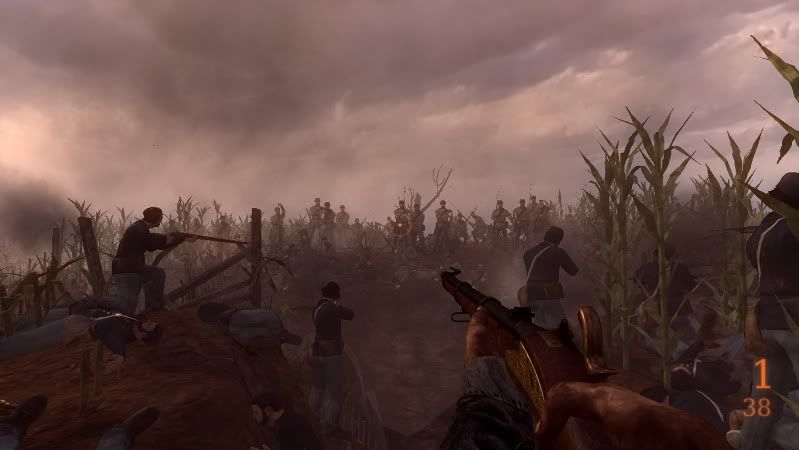
You play as Alexander Morris, a soldier fighting in General Custer's army in the Battle of Little Big Horn. After you get an arrow to the leg, witness Custer's death and are just about to bite it yourself, a portal appears and a guy in a fancy space suit "rescues you" (it's kind of confusing: the guy gets an arrow himself, tells you to hurry and you suddenly go into the portal despite being paralyzed a few moments ago, but never mind), whisking you away to the 22nd century. You awaken in the (apparently one room) HQ of an organization called KronoteK. See, due to a paperwork issue concerning an early transfer, Morris was considered an MIA in the conflict, and KronoteK seeks out these MIAs due to their "recruitment" having a minimal impact in history and thus can be given a second chance at life researching and protecting history. As soon as Morris in brought up to speed by KronoteK higher up "Mother" (shown only as a pair of eyes in a computer monitor); the latter informs him that the organization's founder, Dr. Koell has gone missing and at the same time, disturbances has been appearing all over history, placing vital individuals in harm's way, requiring Morris and his new partner/mentor, Agent Dexter to aid in resolving the situation. It is also quickly established that said disturbances seem to be connected to another group of time travelers, known only as "The Opposition"...

Sounds pretty awesome, right? Well, that constitutes about 70% of the story and the rest goes downhill from there. While the premise would allow immense variety by featuring several individuals to save all across history, the vast majority of the game (about 3/4 to be precise) involves you rescuing TWO guys, one from WWI and another from the American Civil War. Apart from two missions in Little Big Horn, one in World War II, and one in Pompeii the entire game (consisting of X missions) takes place in these two time periods. The plot justifies taking so long to rescue these two idiots by throwing an enormous amount of plot bullshit your way, ranging from beaming in several kilometers away for some reason, the two guys being needed to deliver vital-to-the-success-of-the-war stuff, to mistaking the person you're meant to rescue for his twin brother. To make matters worse, until the very end, we are never even TOLD what significance to history these guys have, making you feel like you're going on a wild goose chase.

And then there are the endless illogical elements in the plot, of which the arrow thing in the beginning is only the first: if KronoteK is so worried about preserving history, judging by Mother's reaction to the Opposition's first attack, why do they allow your mentor to give you several future weapons, going so far as leaving one in a farmhouse full of hostile soldiers? Morris was rescued by having the time bubble appear ''right in front of him''. Why can't we do the same with the other guys? Why does no one pay attention to the Union soldier who seems to appear out of nowhere from time to time and obviously isn't part of the unit mow down Confederate soldiers with a weapon looking, sounding and firing like nothing ever seen before yet panic at the sight of people with the same weapons yet wearing space suits? Why is there a mission where you're accompanied by two redshirts who go missing after the zeppelin they are piloting crash and are completely forgotten about once Dexter tells Mother a fib about them being fine and sure to come back soon? Why does the leader of the Opposition occasionally kidnap you between time trips to tell you that KronoteK are the bad guys yet sends you back every time to mow down his flunkies by the dozen? Finally, why does all of this culminate in an ending so abrupt, pointless and anti-climactic that it makes you shout "What was the point of all this?" The mind boggles.

Gameplay

The core mechanics of the game are standard FPS stuff: no fancy cover system, you can only carry 2 weapons at a time along with grenades, and each one has a (rather weak) melee attack for close quarters combat. The first gimmick the game introduces is the use of weaponry appropriate to the time period of the mission you're on: therefore you'll be using stuff like the Mosin-Nagant rifle and the Mauser C96 pistol in WWI; and the Springfield Musket, Henry Rifle and Colt revolver in the Civil War, amongst other weapons. While the weapons of WWI and your brief jaunt in WWII (more on that in a bit) are pretty decent, for most of the Civil War portions you'll be stuck with the nightmare that is the Springfield single-shot musket. Yes, running around with a gun that only fires a single bullet before having to go through an excruciatingly long reload process is fun for a while but it gets old VERY quickly. And yet that is the gun that 95% of all enemies are carrying so you'd better get used to it. Add that to the terrible AI of the game and you have some hilarious moments, such as enemies standing in the middle of an open field shooting at you, then reloading for about 5 seconds while you take out your sidearm and shoot them in the head. Or, if you have no other weapon handy, get involved in the Civil War equivalent of a quick draw gun battle, where you try to reload before the other guy does. It's as ridiculous as it sounds. Then there's the future weaponry: every so often Dexter will give you a future weapon whenever there is the need to perform "numerical adjustment" (as he puts it) to opposing armies. As fun as this sounds, most of the time he'll give you the futuristic shotgun or the futuristic assault rifle, which despite looking flashy are your typical FPS shotgun and rifle. In certain missions you do get access to cooler weapons (such as a weird rocket launcher/artillery cannon hybrid, an auto aiming machine gun and an awesome sniper rifle), but these are few and far between.

Speaking of reloading, another thing the game introduces is an "active reload" system: every time you reload your weapon, a circular meter indicating your progress starts filling up and if you press the fire button when it hits a green section along the meter, the reload process is immediately completed. However, if you miss, the gun jams making said reloading longer. This mechanic ends up being a godsend for most weapons (especially the musket) yet appears to be slightly buggy: every so often, instead of getting the "jam" animation, your character simply holds the empty weapon making you having to switch weapons and back again to be able to fire, in a matter that is clearly a bug, not a feature.

The final gimmick is blue aura enemies. These are people that while not apparently as vital to history as the (gold aura) people whose rescue is the focus of the mission, are still important enough to keep alive. What this means in gameplay terms is that they must be taken down by either shooting them in the legs or using a bunch of pebble-like devices called "chasers" that when thrown seek out these special enemies and give them an electric shock that knocks them out. Unfortunately, every so often these chasers, despite being supposed to come back when thrown will get stuck or you'll be forced to run away from the place where you threw them so there may be times when you have none available. Not to mention they have some trouble seeking blue auras when not in a specific range, so you may have to throw them several times.

But what happens if you kill these people? Well, sometimes (this was probably supposed to happen every time judging by the trailer. Yup, yet another bug) this causes a bunch of Opposition mooks to warp in, which, due to their better weapons and body armor, often cause your survival chances to drop. Not killing blue auras also gives you a bonus to upgrade points you receive at the end of each mission to upgrade your weapons (in clip size, reload speed, accuracy and rate of fire). Why these upgrades carry to every weapon you pick up is never explained but whatever. Time travel.

Now you must asking: is all this stuff placed inside a decent game? The answer is no: 80% of gameplay resumes to "Go here" and "Kill these guys". Sure, every so often you have to protect those ever-so-important NPC characters, but since they seem to be not only bulletproof but also have the ability to teleport near you if you go too far away, those "escort missions" end up being exactly the same as the afore mentioned "Go here" and "Kill these guys" objectives. Apart from a few decent set pieces (such as a jaunt on a zeppelin and a really atmospheric mission in a Nazi POW camp, the game's definitive high point), you have one of the most barebones shooters ever.
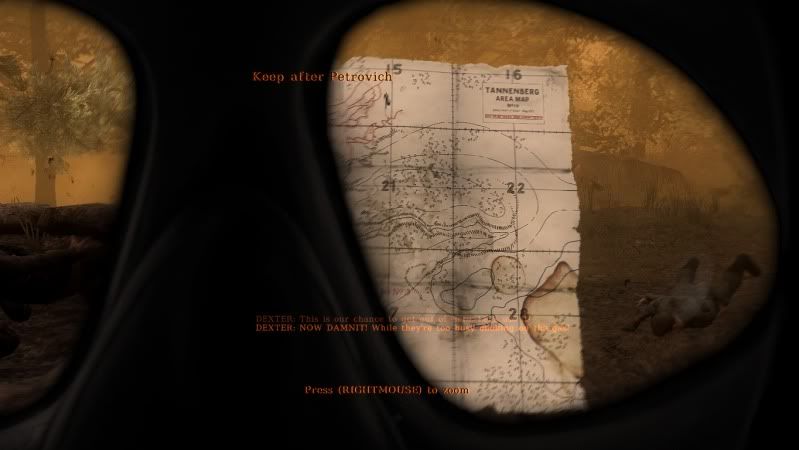
And if that wasn't enough we have some utterly bizarre design decisions: in one mission in WWI, mustard gas is released and you put on a gas mask. The mask ends up covering more than half the screen and judging by it's placement, you'd think they either didn't put the eye holes in the right places or that Morris is a cyclops. And then when you bring up the map, said map ends up being almost completely covered by the mask. That caused me to wander blindly for at least 5 minutes before realizing that the place where I was supposed to go to was the opposite direction of the way I was facing initially, which I could have easily verified if I could look at the map!

And then there's the invisible walls. Not only is there a game developer with the audacity to use invisible walls in this day and age, said walls are all over the place: not just the borders of the map, there are invisible walls around lakes, invisible walls around cliffs (despite the game having both swimming and fall damage), invisible walls around cliffs that you could easily climb otherwise, invisible walls in the middle of nowhere, etc. It seems that the only way to get around without bumping into an invisible wall is to strictly follow what the map defines as a road, in essence reducing the area show in your map to about 1/9th of the size.

And in the moments where you're actually shooting people? Most of the time it's pretty standard until the several times when the game throws a crapton of enemies at you, all of whom are capable of shooting you from really long distances without you knowing where the hell they are. Sometimes it gets so irritating that it just makes you give up and try running towards the next objective. And it works too, though it can bite you in the ass sometimes (one particularly embarrassing incident occurred when I, armed with only a Colt revolver and facing off against 30 Union soldiers made a break for it...only to face off against two armored Opposition members armed with machine pistols). As you can imagine, all of this makes for a very aggravating gaming experience.

Sound

There's really not much to say here. The soundtrack is pretty generic and repetitive, and the weapon sound effects at times make you feel as if you are firing BB guns or lighting firecrackers. instead of actual firearms. The voice acting is all over the place: the NPCs have pretty flat dialogue, Mother's voice keeps changing between accents, Dexter does a good job but his voice is COMPLETELY wrong for his character: he is supposed to be a New York firefighter who went MIA on 9/11, but he sounds more like a cowboy mixed with an Army veteran.

Graphics

The developers have bragged in press releases and the like of their "Marmoset Engine", which allows them to render "Hundreds of enemies at once". Well, I can't fault them there: we do get a lot of enemies on screen at once and without any slowdown even on a mid-range machine. Of course, when the rest of the game looks like a PS2 title and all the enemies look the same with only a few different models here and there, that isn't much of an achievement. The textures are high-res but really repetitive. The level terrain looks incredibly dull and with hardly any points of reference, so you'll be stuck looking at your map most of the time (usually only stopping when someone is about to shoot you). The only exceptions to this are the aforementioned POW level and the final level set in Pompeii, which look rather neat but that ends up being too little too late. And even those levels end up being ruined due to the repetitiveness of the models: all of the great ambiance of the POW camp goes straight to hell once you find the guy you were sent to look for...in the middle of a crowd full of models looking exactly like him.

Conclusion

Darkest of Days has some high points, but its merits in no way outweigh its flaws. It's quite simply a terrible game. It's so bad it's not even mock worthy: if there was an MST3K for games, this game would be the equivalent to Monster a Go-Go or The Beast Of Yucca Flats, in the sense that not even riffing can make it bearable. I know this is a debut game, but there is such a thing as aiming your sights too high and this what happens when you do. Recommendation: stay the hell away from this game. Darkest Of Days, indeed.

Grade: D.

Psyclone has, in the past, also reviewed Burnout Paradise for GBG.

Read Full Article

Monday, February 18, 2008

Review: Burnout Paradise


Have a guest review in from Psyclone today, because I refuse to buy another gaming console. -GB

The popular Burnout series finally makes it's next-gen debut. The developers have repeatedly stated that this was to be a "complete re-invention" of the series to mirror the change in hardware. Does it manage to maintain the same entertainment value of it's predecessors? And is it really a "complete re-invention"? The answer to those questions: "Hell Yes" and "Uh...kinda". Read below to find out why.

Gameplay:

The most noteworthy addition to the game is obviously the open world of Paradise City. And by gum, it's amazing. Not only is it huge in area, but there is also quite a bit to it vertically: areas under and over highways, a completely empty rail system you can use to get around, parking garages that you can use to explore ROOFTOPS, etc. The game teases you to find every single short cut (signaled by flimsy fences with "Private Property" signs that you can bust through), bust through every single Burnout billboard scattered through the city (some of them in really out-of-the-way places) and jump through every single "Super Jump" (you know you're in one due to the awesome slo-mo cam and the huge "Super Jump" caption in the corner of the screen), though unfortunately these don't allow progression in the game. For that you have to compete in the game's events.

And there are a lot of those too. There are a grand total of 120 events in Paradise City: and unlike most games of this kind all of them are available right from the start. The game progression works with a "license" system: you gain a "Learner's Permit" at first then move up to the "D License" then "C License", etc, as you complete events. Every time you upgrade your license, you gain a new car, the events become harder (race competitors get better cars, you need more takedowns to win Road Rage events, etc) and the events you completed are reset, so you can do them again (only this time they're harder, as stated). Also, every time you win a certain number of events, a new car is unleashed upon Paradise and to unlock it you must find it and take it down. This can be a bit tiresome at times :the cars seem to just show up after you drive around for a while and some of them seem to crash a little TOO often (making you have to wait until they respawn so you can take them down), never the less, it's an refreshing rake on the "unlocking" concept.

And where do these crashed cars go? To the junkyard, of course. Junkyards are scattered across the city and serve as the points where you can choose a new vehicle. Also scattered across Paradise are Auto Repair Shops (which, shockingly, repair your vehicle), Paint Shops (which randomly repaint your car) and Gas Stations (which refill your boost meter). These three can be used even during events, which makes them very useful (especially Auto Repair during Road Rage and Marked Man events).

When you get to the cars themselves, however, you start to question the "complete re-invention" promise: the cars have been split into three classes that turn their boost mechanics into some sort of "Burnout Greatest Hits Collection". The classes are Stunt, Speed and Aggression and each car has the classic stats of Boost, Speed and Strength. Stunt cars have the most accessible boost mechanics: boost fills up by the usual means (takedowns, driving in oncoming traffic, near misses, etc), being filled up faster by stuff like jumps, barrel rolls, flats spins, etc. They also have the most balanced stats. Aggression cars' boost fills up VERY slowly except for traffic checking (which is utterly worthless in this game, since only cars with near maximum strength can hit traffic from behind at high speeds without wrecking and hitting them from the sides doesn't register at times) and takedowns. Takedowns with Agression cars are the only ones that use the Burnout 3 mechanic of increasing the boost meter with each takedown. These cars have the highest Strength stats but have very low speed. Finally Speed cars are throwbacks to the original Burnout: boost cannot be used until the boost bar fills up, yet these cars are the only ones capable of chaining Burnouts. Speed cars are fast, but usually fragile.

The throwbacks end in the events however. Every traffic light in Paradise City corresponds to a certain event which starts at that light, however each event (with the exception of Road Rage and Stunt Run, more on those later) has it's finish line at only 8 different landmarks. That's right. They don't even try to hide it: they showcase all of them in the opening video. While this may seem a little dodgy it soon becomes rather irrelevant once you get used to the game's new event structure.

The thing that might get on most people's nerves is how all events have embraced the open world structure, for better or for worse. The one that is most impacted and may frustrate people is the basic race. Instead of having a looping track or a straight run with invisible barriers (like in Need For Speed: Underground 2 and the like), the game instead allows players to choose their own route, making it a cross between Burnout and Crazy Taxi at times. In order to help players who don't want to memorize the entire map from the get go, the game possesses three critical tools: the minimap, the compass, and the (often ignored) turn signal. The minimap, obviously shows the map of your immediate surroundings. The compass always points toward the finish line and tells you the distance to it (and more importantly whether you're approaching your objective or moving away from it). The turn signal is the AI's way to suggest a route: whenever you approach an intersection, your car's turn signal will light up and the name of the suggested road you take flashes on top of the screen. Unfortunately, even though it has all this and you hear a tone indicating you must turn, it's still VERY easy to miss the turn when you're cruising a Burnout's breakneck speeds. Even more unfortunately, sometimes that could mean the difference between defeat an victory, especially in certain regions like the outskirts of the city (where there aren't many intersections), when you mistakenly enter a freeway (which despite being riddled with holes in the walls and exist ramps, are STILL a tad difficult to leave at times) or when you are very close to the finish line (in that case it's your fault). Also, obviously, the turn signal doesn't include shortcuts, making shortcut taking kind of a double edge sword in which you either cut down race time dramatically or end up stuck in such a long route, you might as well quit the race. This can of course be compensated with knowing the city, but it's still a (relatively uncommon) annoyance. Naturally this open ended nature removes the infamous "rubberband AI" so you can finally brag about finishing a race way before anyone else.

The only other events that remain beside Races from the previous Burnouts are Road Rage and Burning Laps (now obviously renamed Burning Routes). Road Rage has possibly the best overhaul since you are no longer constricted by a track: now the entire city becomes your battle field as you and a brand of respawning rogues duke it out trying to reach the all time takedown record. Since this in this event the rubberband AI remains, you can easily take the battle all across Paradise much to the terror of it's denizens. Burning Routes boil down to getting your car from Point A to one of the 8 Landmarks in x time. Burning Routes are tied to individual vehicles and beating them unlocks a tweaked version of that vehicle for you to use.

The new events were designed from the get go with open-endedness in mind: Marked Man and Stunt Run. Marked Man has you go from Point A to Landmark B while being hounded by maniacs in extremely tough black cars without getting totalled (like in Road Rage you can crash a couple of times but if your damage gets past "Critical", it's over). In this kind of event it's all about trying to avoid them, taking them down to gain time and going the shortest way possible. Great fun. The final event is Stunt Run. Basically Tony Hawk with cars: you run around trying to chain together combos of boosting, drifting, barrel rolling, jumping and flat spinning for the maximum points possible. While laughably easy at first, eventually it gets to the point that, also like Tony Hawk in a sense, you have to "memorize" the perfect "lines" in order to win.

Thanks to the growing trend of "Achievements" in games, Criterion has thrown in a bunch in both console versions (the PS3 version achievements are called "Paradise Awards" and naturally, can't be shown off) to keep players occupied. From the laughably easy (finish your first race, upgrade your license), to the intermediate (chain x Burnouts, make a 260 flatspin) to the hardcore (100% completion), there is something for everyone.

Baffling however are the so called "Road Rules": every road in Paradise has an associated time record and Showtime record (more about that in a sec). Beat them both and you've "dominated the road". You can also have your console look for records online for you to beat and upload. This serves for absolutely no purpose than 100% completion (which makes said completion fall into the realm of, as the great Yahtzee would say, "unemployed psychotics and Koreans"), bragging rights and/or online pissing contests, IMHO. If you enjoy getting your name in the leader boards, be my guest. Not to mention some roads have no business having records. For instance, you get an achievement for beating the offline time of a road that is literally about 300 meters long! And if you go to the online records, people are desperately trying to defeat the current record of 2.4 SECONDS! WTF?

And then there's Showtime: the single greatest disappointment in the game. If Crash mode was, in your opinion, the single greatest thing about the Burnout series, then by all means, do NOT buy this game. Showtime is basically a shadow of Crash Mode's former self. Gone is the strategy, the puzzle element and the satisfaction. Basically, you drive somewhere, activate Showtime and your car starts bouncing around at which point you try to guide it around and hitting the boost button to make it jump into cars. It's laughably easy at times, and incredibly pointless (unless you want to try to make the crash cross the entire city for some inane reason). And, like the billboards, and jumps, offers no progression in the game. One has to wonder what Criterion was even thinking (besides the aforementioned pissing contests).

The interface in this game has been kept to a minimum. You can almost go through the game without looking at a menu screen. Every single common action can be made in the game itself. Want to start an event? Pull up to a traffic light and press the brake and the gas. Want to end an event? Just stop the car. People may get annoyed with the fact that you can't reset an event (especially when you're going for the Burning Routes), but there are so many events that you can just start another one right away (unless you happen to be in the town's outskirts, in which the events are more sparse, but even that can be forgiven)

Sound:

Once again the soundtrack is nothing to write home about. From crappy punk, to some techno and rock, the soundtrack is as ho hum as it ever was. In fact, you may not even notice it while you play... until Avril Lavigne's "Girlfriend" starts playing, at which point it's all you can hear until you hit the ever so helpful "track skip" button.

The sound effects are good as usual: the whooosh of the boost, the sound of metal crumpling in slow motion when you crash, the clash of two speeding cars, etc. It may sound a little under-whelming at times, but overall it's excellent.
A (relative) improvement in this game sound wise is the DJ. After learning their lesson after hiring DJ "I Can't Believe This Annoying F**ker Works At An Actual Radio Station" Stryker for Takedown, EA decided to get the more well received DJ Atomika from SSX 3 to takeover Crash FM. Unfortunately, he seems to be a tad bitter with his transfer, since his amusing anecdotes from SSX 3 have vanished and only speaks to spout out newbie level hints which at times sound quite condescending (for example, after losing an event, he may say something along the lines of "You lost? Here's some hints: drive fast, and don't crash!". Gee, thank you, Mr DJ!). He does remain mostly quiet though, which is always a plus.

Graphics:

Once again, Criterion did a great job graphics wise. Everything in the game looks gorgeous and (in the PS3 version at least) completely devoid of slowdown.
Paradise City is very diversely designed city. Taking influences from several American cities, it manages to seem varied though you're technically not leaving the city. The outskirts of the town also manage to bring some variety to the events thanks to it's countryside feel.

The lighting effects, particularly on the cars look amazing. Though the civilian cars' models are once again not very detailed, that's largely irrelevant. The player controlled cars, however remain great as ever. You may notice pop up with the civilian traffic and a few pixellated scratches on crashed cars, but the game is still beautiful. The sense of speed the series is known for remains overwhelming, even in the first vehicle you get.

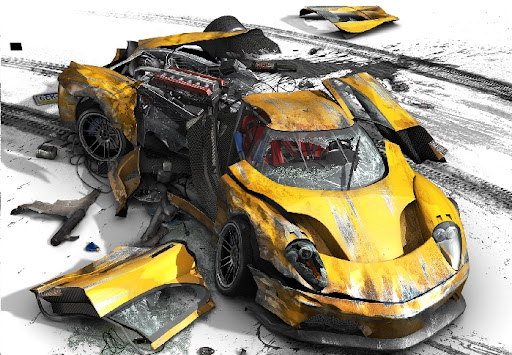
And the crashes. The crashes look better than ever. The bits of metal flying through the road, the metal crumpling in slow motion when you collide head on into a wall of another vehicle, all looks amazing. Criterion has truly taken advantage of the next-gen consoles' power.

Conclusion:

If you're a fan of the series then you may object to some of the things this game does. However, if you're like me, you'll be able to forgive it, because the rest is a great gaming experience. This game is truly much more than the sum of its parts and everyone with a next-gen console owes it to himself to try it out. It's a few points short of being perfect, but it's heavily recommended.

Verdict: A-
-Psyclone

Read Full Article