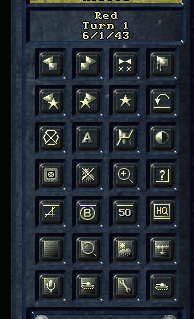
Here’s another example: this is the control panel that you use to control units in Norm Kroger’s Operational Art of War III:
So in the world of TOAW, “Next unit” is as important as “resolve battle” which is as important as “show/hide hex grid” which is as important as the twenty-five other miscellaneous options, some of which you will never use. It is to weep.
Ok, Ok, I know. How comedic is it that immediately after ending a review with "starting next week, I'll start reviewing new games" I immediately disappear for umpteen weeks? I don't know why you people continue to put up with me.
Ok, enough of that. Here's what I got goin' now-
Settlers 7. My first thought upon seeing this title was "There were SIX more of these?" I remember hearing of "The Settlers," and maybe Settlers 3 I think at one point, but holy under-the-radar, Batman! Let's start off, though, with that boxart. I guess Ubisoft thought Americans would be put off by the game if the box art actually conveyed an accurate portrayal of the game. For that accurate portrayal, we turn to the UK box art -
Kind of makes the US box art look a little.. disingenuous? Perhaps even fraudulent?
It's a little hard to classify S7. To me, it sort of seems to be the sheltered child of an RTS and an Economics Sim that heavily favors its mother. "Heavy on resource management" doesn't even begin to describe what's going on here, though thankfully a great amount of it can be automated. This is good, because otherwise managing said resources would be a real nightmare and not give you time for anything else.
The basic premise of the game is that you, benevolent monarch that you are, want to conquer your neighbors so their people can experience your enlightened leadership. Now, to do so, you don't actually have to go kill the rival monarch. In fact, I've never actually completely eradicated one of the opponent characters by obliteration. Victory conditions are usually defined by having a combination of largest population, most territory, most money, biggest army, most combat kills, most trade routes, most prestige, most research done, and so on and so forth. Whoever gets 5 out of 7 or so of these conditions met is simply declared the winner.
So how you go about this sort of thing is rather convoluted. You need territory, obviously, because everything you do takes a building (or two, or three) and buildings take space. So you need an army to conquer neighboring provinces (or lots of priestly types to proselytize them), and to raise an army takes resources. You can just recruit men at your local tavern, but that costs a lot of gold and food. It'd be more economical to train them from scratch, but to do that you have to build a stronghold, which requires a prestige upgrade be claimed, and it requires weapons, which have to be made at a blacksmith, which requires coal and iron, which has to be smelted at a smelter, which requires iron ore, which has to be mined (along with the coal from earlier in the chain), and all this stuff has to be carried from the mine to the smelter back to your blacksmith to your stronghold, all of which might actually be miles apart. Oh, and the blacksmith needs wood, too, for the weapon handles I guess, so you better have somebody cutting down some of that, too.
It should also go without saying that the computer can usually do this faster than you. So it's lucky that if you set up things well, it will usually happen semi-automatically.
So you're building armies and conquering lands, all while trying to keep your populace fed, and keeping trade goods being manufactured so you can make money or get resources you're short on via trading with distant lands, and also trying to research technologies to gain the upper hand in production and war. I find it slightly ironic that the sole vehicle of technological advancement in S7 is basically the Catholic church... and that researching these technologies somehow actually physically consumes the clergymen involved. Oh, and the primary resource for training up more priests? Beer. (Which is made in a brewery you have to build from grain and water, which you have to grow at a farm and build a well to get respectively, etc).
I mean, really.. does it REALLY take the ritual sacrifice of four priests to teach your people the ability to chop down a tree if it is in the way of something you want built?
Combat also is incredibly mundane. Because there's no strategy or tactics involved, it pretty much 99% of the time comes down to who's got the most guys, and the most "advanced" guys. And considering there's a whopping 4 different types of units in the game, there's not a whole lot of advancement to do.
And don't even get me started on the whole "plain food/fancy food" dichotomy. Many of the tasks that can be performed in the game for no food cost double in output if you have it consume plain food, and QUADRUPLE if you let it consume fancy food. Explain to me exactly how it is that eating sausage makes a given artisan produce twice as much beer, cloth, whatever from the SAME raw materials as he did when he was only eating fish?
Anyway, once you get your mind wrapped around the bizarre rules of the economy, you then have to learn to contend with the "gotchas." I hate "gotchas." Gotchas are surprises (usually intentional) that developers put in to force you to replay a given section of game multiple times. For example, in one level of the single player campaign, when invading a given territory I was forced to fight double the number of static defense emplacements as was present in EVERY SINGLE OTHER part of the game. It looked like it might could have been accidental due to poor pathing, but there it was.. because there were twice as many cannons to go through, my army got annihilated and the CPU stomped all over me. And this was already over an hour into that level... so I was forced to replay the whole level from the beginning.
So you learn how bizarro-economy works, and you start to expect the "gotchas," and it's about this time that the game crashes. Yes, the game has some serious technical problems. The fairly regular game crashes are somewhat mitigated by the autosave feature at least, but the problem with the autosave feature is that when autosaving, the game locks up for about 45 seconds. And to top it all off, this is a ubisoft game, which means (you guessed it) "Go go gadget super-tattle DRM!" Sickening. And speaking of revolting game components that connect to online servers, the game asks if I want to post my latest achievement to my facebook status practically every time one of my settlers sneezes. Ugh! Of all the horrible things game developers have done to us over the years, I'm putting facebook integration right there at the top of the list of "most abhorrent."
Well, despite all that, it was a bit engrossing for a few days. But I don't feel the need to play it any more.
Grade: C-.
And speaking of disingenuous promotional media... I can't believe they seriously expected this audio to match this video.
I can't remember the last time I was so pumped over a game coming out. Supreme Commander 2. The sequel to, hands down, the best RTS game ever made. It had some pretty enormous shoes to fill. All these high expectations, though, are probably why I find myself disappointed in the direction they took with the game.
Supreme Commander 2 takes place 20 years after the defeat of the Seraphim in the Forged Alliance expansion for Supreme Commander 1. In the absence of a greater external threat, the various races have found one thinly plausable reason or another to start shooting each other again, if only on a small scale. But nobody really cares about the plot, right? The Supreme Commander franchise attracts those who value complex strategy without micromanagement, right?
Well, that may not be the case any more. While still mercifully devoid of micromanagment, the game has been stripped of the vast majority of its complexity. Why would they do this, you might wonder? Well, here's another travesty the blame for which we can lay at the feet of a developer's desire to dumb things down for the console tards. Since SC2 is being released on both PC and XB360, the lowest common denominator of both man and machine had to be pandered to.
So what did they do? Sheesh, where to begin... The very first thing I noticed was that they bolloxed up the "right click and hold" formation command, which irritated me all the way through my time in the game. They also removed the tech tier system, and now instead of building and upgrading structures and units in this method, they've added a third "resource" to the game called "research" which is generated by combat and by "Research Lab" buildings which constantly generate it akin to mass extractors. You can then spend these resource points to buy new unit types and upgrades to existing ones, and the effects immediately propogate to all your existing forces. This means there's no such thing as a "tech 2 tank" or a "tech 3 gunship" or anything like that. You never have to ramp up to the higher tech generators nor upgrade your mass extractors. There is only 1 kind of point defense gun per faction, and one kind of air defense turret, just to irritate more those of us who liked the old paradigm. Additionally, the bonuses you used to get from placing resource structures next to other structures is gone. There's also no cap on resources anymore (or rather, every resource is capped at 99,999 and that cap doesn't change ever), so no need to build storage structures. As the company promised, there are more experimental units... but they do less. Take the good ol' UEF "Fatboy." For some reason, the Fatboy 2 is *weaker* than the first incarnation - its guns are less devastating, and it is no longer a self-contained factory. It's gone from the must-have unit of the UEF to a unit I only use if nothing stronger is available, a pale shadow of its former glory. Cybran fans take heart though, your precious experimental gunship is just as overpowered as it ever was... which I guess is a good thing because the rest of the cybran military seems to be paper mache and terminally nearsighted, but I'm getting off track. The tradeoff for simpler (and in some cases weaker) experimental units is that experimentals now cost much less to build in both time and resources. The longest build time is 2 minutes and 30 seconds. I remember in SC1 having to use every engineer at my disposal to get certain experimentals done in as short as 20 minutes. That reminds me - engineers can no longer assist each other in building or repairing. What this means is that instead of grouping 3 or 4 engineers to build things more quickly, you have to get used to using 1-engineer-1-project concepts and strategies. They've also dumbed down how resources are spent. Instead of using the resource cost over time as in the first games, and slowing production (or stopping it) if and when resources run out, you now have to pay the full resource cost up front like every other RTS in the genre. Way to stop standing out from the crowd, GPG. Energy management is also practically a non-issue because energy generators are now the cheapest structure in the game, and are fast to build and take up little room, so if you're ever actually low on energy, you're a goddamned idiot who needs to be kept on a leash to stop you from wandering into traffic.
The one thing I can say that HAS improved since the first game is engineer AI. Engineers will now, by default, repair any damage within their range and salvage any wreckage in range without being told to do so. This means an idle engineer or two amidst a cluster of defensive structure dramatically increase its longevity, and therefore utility. So they did find a way to improve something.
But there's also some things they made worse that can't even be explained by the console factor - when building shields, the radius of the shield generator no longer is displayed during placement, so you have to sort of "guess" where the furthest extent of the shield will be. None of the defensive structures are particularly long range, so the few units that DO have range longer than your basic tech 1 point defense cannon are suddenly a whole lot better at tearing apart a base from outside the range of its defenses (hello, Megalith). Most of the maps are smaller (so small in fact that I wonder if Demigod slept with Supreme Commander 1's wife), and even on the ones that aren't tiny, it doesn't particularly matter. There are new "cheese factor" experimentals that let you put units right smack into the middle of an enemy base with absolutely no countermeasure other than to keep a huge number of units or defensive structures built throughout the entirety of your base at all times. Because if there's any part of your base not defended like fort knox, that's where the opponent's "noah unit cannon" or "Space temple" or whatever is going to drop a bajillion units that will rip out your guts through your back door and leave them steaming gently on the pavement. The funny thing is, the AI never thinks to do this, but once YOU do, you can pretty much beat any level pretty quick. And you DO think of this strategy soon, because there's a mission in the early part of the single player campaign that SPOON FEEDS YOU THIS STRATEGY. Then, in case you're dense, there's ANOTHER level later that has you do it again! At this point, even the console kids who other console kids think are slow, the ones who only have a brain stem, will be thinking "gee, this 'teleport into the enemy base' tactic sure makes this easy. I should do that all the time, huh?'"
Ok, all snarkiness aside, you know what? It's a passable RTS. If there was a world where SC1 didn't exist, and this came out, I'd call it a pretty, somewhat bland RTS that doesn't really stand out from the pack all that much. But you know what? This is supposed to be Supreme Frickin' Commander. I expect better from you, Gas Powered Games. Shame on you. Shame. On. You.
We don't currently plan to support LAN play with StarCraft II, as we are building Battle.net to be the ideal destination for multiplayer gaming with StarCraft II and future Blizzard Entertainment games. While this was a difficult decision for us, we felt that moving away from LAN play and directing players to our upgraded Battle.net service was the best option to ensure a quality multiplayer experience with StarCraft II and safeguard against piracy.
Gas Powered Games, creators of the Supreme Commander franchise and other heavyweight strategy games, has released Demigod. The premise is that it is a hybrid action/strategy/rpg type game.
Graphics The graphics are really well done here. The levels are lovingly detailed, the individual models are well textured and modeled. Usually teensy tiny minion type sprites suffer from a lack of polygons, but not here. There's also lots of little touches and beautiful artistry that make the game a joy to look at.
Sound The sound is well done. The voices serve their purpose, the sound effects do their job admirably, and the musical score is thematic and immersive. All in all, a well done auditory experience. There's even a tiny touch of humor buried in there from time to time... for instance, once when choosing a character to play as, I heard him say "This armor itches."
Gameplay Demigod is a hard animal to classify. You're on a map with a bases, defenses, and control points, but you can't control any unit other than your own character. You have armies that spawn regularly from portals and rush in a half-thought-out manner toward the enemy lines to take objectives and fight until they die. Your avatar "levels up" and you choose new abilities (or upgrades to existing abilities) as you do, making your Demigod stronger in the fight. Your ability to take and hold flags determines things like how strong your armies are, how often you can use special abilities, and how fast you accrue gold. Said gold can be spent at "shops" on the map for a variety of things ranging from straightforward potions (drink this for more health/mana) to unique artifacts, and can also be spent at your "citadel" for upgrades to your army or defenses.
What this leads to is a semi-strategic tussle that lasts about 20 to 30 minutes and is all decided in the first 3 to 5 minutes of play. It can be fun to stretch yourself against CPU enemies, but multiplayer can often be an excercise in frustration... for somebody it ALWAYS will be. Because once you start losing in the beginning to a player, there's often very little you can do to turn the tide since base defenses cannot be rebuilt in any way, shape or form.
There are 8 different demigod characters to chose from, each with their own methodology of play. That helps with replayability some, but I was a little surprised at the low number of maps to play on. That hurts replayability quite a bit.
The inevitable comparison to the custom map "Defense of the Ancients" for Warcraft 3 must be made. This game borrows heavily from the DOTA paradigm, perhaps leaving many to wonder why they need to "buy DOTA again." But if you never played DOTA or never really were able to get into it (like me), this may make a good introduction (or re-introduction) to that type of gameplay experience.
There's also a bit of a stumbling block in that there's no tutorial, so at first the learning curve seems steep. However, a try or two through a short game on easy will very quickly have the player learning the ropes... and since the matches are short, learning the game is not a long and painful process.
Verdict Demigod looks complicated but is actually a very quick and simple game. Such a game is fine so long as replayability is there, and Demigod has aspects that encourage that replayability such as multiple diverse player characters and an achievement system. A narrow selection of available playfields hurts it some. The game is pretty and sounds good, but it's very much on the casual side of the spectrum. I'd pay 20 bucks for it and not feel out of sorts. Maybe not so for $40+ however.
Another game that snuck up on me. The FPS/Survival horror hybrid "Cryostasis" had little fanfare or hype preceding it. I'm never sure whether this biases me for or against a title. On the one hand, I hate how crappy shovelware games are overhyped to make them sound so much better than they are, but on the other hand, being completely off my radar until launch often also means there's nothing to recommend a game... so is Cryostasis another foreign-made sleeper hit, a-la Serious Sam, or just another low budget stinker from a small foreign dev house? Read on.
Graphics - Clearly these guys were going for the brass ring here, and you'll need some heavy duty hardware to pull it off properly. The minimum specs for an Nvidia 7800, but it recommends an 8800. The game is very high poly count(though some of the textures are a teensy low res), and there's a whole lot of post production filters and aftereffects being applied to assist with the visuals. The game is also the first to use PhysX water effects (as seen in engine tech demo footage here). Overall they did a very good job of creating a gloomy, rotten, oppressive atmosphere full of quasi-human monstrosities. There is a minor irritation in that your character often chooses the oddest moments to randomly lift up his gun for inspection, obstructing the center of your viewing area. But this is quickly remedied with a right click.
Audio - The sound effects are good quality, and the ambient noise adds to the atmosphere and suspense. I was pleasantly surprised at the quality of the voice acting and how few awkward translations were in the dialogue. The hollow clunking and groaning of a gigantic derelict ship locked in a glacier makes for a very eerie setting. I can't help shake the feeling though that the noises made by the enemy creatures are snagged from another game... I want to say MDK or possibly Everquest. It's a small nit to pick though.
Gameplay Cryostasis, as mentioned earlier, is an FPS with a strong bias for the Survival Horror genre. It is 1981, and your character has been sent to investigate a stranded nuclear icebreaker ship. It immediately becomes apparent that most of the crew has either died or fled the ship (to die in the arctic ice), and those that have not (and perhaps even some that did) have somehow been changed into what I came to call "Creatures of the Cold."
See, temperature is the central focus of this game. Your core body temperature is your health meter, and it gradually lowers or raises depending on the ambient temperature of your surroundings. When a Creature of the Cold attacks you, the damage comes in the form of your internal body temperature plummeting a few degrees. If you are in an extremely cold environment (such as outside during a full blown arctic snowstorm with winds around 60mph and visibility of about arm's length) you periodically take "damage," and if you do something egregiously dumb like go for a swim without thermal scuba gear, you can be frozen to death instantly.
So the game quickly becomes a quest to survive from one heat source to the next. You heal yourself by warming up at something hot, such as a fire, a running engine, even a desk lamp if you're really in a pinch (and you often will be). Every heat source will not be enough to raise you to full (particularly not desk lamps), but the game is pretty good about giving you good heat sources when it thinks you're going to need to take a lot of damage in the near future. Of course, once you figure this out, this has the side effect of making you feel the least nervous when your temperature is almost zero and there's no heat sources around, because you know the game won't drop a creature on you until you come to a part of the level that has a heat source in it, so ironically you feel safest when you are closest to dying.
The weaponry in the game consists of three melee weapons and a variety of firearms. The first weapon you improvise by wrapping a lock and chain around one fist and punching with it. The second is a waterpipe valve you happen to rip from its place and use like brass knuckles. At a fairly early point you will come upon a fire axe and start doing some respectable damage; three hits from the fire axe kills most creatures, though it does have a slightly disorienting effect on your point of view since you "put your back into it" so to speak and your viewpoint reflects the realistic movement of your head in the swing... IE, you see your arms, then you see the floor, then you stand up again. There's a bolt action rifle, the same rifle with a sniper scope, a semi auto rifle, a SMG and even a flare gun which is supposed to be able to distract enemies with its heat in addition to damaging them. Your life is complicated by the fact that there is no targeting reticle... if you aren't right clicking to aim down the barrel, you literally are having to "eyeball it" which means you'll probably miss a lot.
The creatures themselves also follow a similar progression, and range from your standard frozen zombie looking guy to nightmare fuel not of this earth. There's the regular unarmed zombie guy (fat and thin versions), the zombie guy with an axe, the zombie guy with welder's gear, the zombie guy with a rifle, the zombie guy with the semi auto rifle, the zombie guy with a machine gun whose HEAD has been scooped out from the front with a fist sized melon-baller and had a blue light put in the cavity with a metal grate over it, the guy who's mutated into some kind of flying insect... all immune to cold and bearing limitless hostility toward anything exothermic. One particular "boss" type mob I find particularly perplexing... because he basically looks like a guy in a raincoat and a metal hat who has secured SMGs to each elbow with leather belts because his hands are too busy holding flashlights and being bolted through the wrists, secured to his helmet. The result is almost comical with a dash of "wtf" and an aftertaste of "yecch." The brig section also introduces "guy with goggles wrapped up like a mummy holding jail keys between his fingers clawing you up like he thinks he's wolverine." Uh. Ok.
But that's not all... apparently your character is some manner of psychic, though it may just be a side effect of whatever the hell is going on in this creaky old boat at the north pole. Often you will come across the frozen corpse of a crewman, usually in such an arrangement that it is part of some obstacle to your progress. For instance, you may find a corpsicle half sticking out of a block of ice and snow protruding from a door that was forced open by a deluge and the accumulation of frozen water is now blocking your path onward. Your character has some kind of psych ability that is part vulcan mind meld, part quantum leap. By touching the corpse, you will then experience the past through the eyes of the dead man, but you can have him behave differently so that history is changed and he does not die. To continue the above example, you could touch the corpse half-sticking out of the ice and snow buildup, and relive his final moments in the boat's accident, but instead of dying when the door bursts open and the frigid water overwhelms him, you might find a wrench on the ground and quickly use it to open a nearby valve, draining the adjacent room of the water threatening to overwhelm the bulkhead, thus saving the crewman's life. When you return to your own body, you'll find the corpse no longer there, the ice and snow absent, and the door undamaged, allowing you to continue on your way.
Pity I can't seem to find the captain's corpse, or I could have just quantum leaped into him and had him turn the boat straight south and sail away from the arctic. But then, I guess we wouldn't have a game, then, would we?
Now, it does have a bug here and there. There's been a few times that I loaded a saved game only to crash in the middle of the load, or when the load completed found that some bug has rendered progress impossible. For example, there's a part where you first get a rifle and ammo, and you need it to shoot a ladder so it falls to where you can climb it... the game autosaved when I picked up the rifle, then I picked up the ammo and shot the ladder. I climbed up and died shortly after to a Creature... the autosave put me back down after having gotten the rifle but the ammo was not there, thus I could not shoot the ladder. I had to go to an earlier save to get past that. Save early, save often, and don't always overwrite your save. There was also a part in the ship's brig (I swear there was something like 40 people in this brig, this is one hell of a ship) where I shot what I thought was a Creature of the Cold, but for some reason shooting THIS creature killed me instantly as if I had shot myself in the head. Oh, that was a nice surprise, I guess I'm not allowed to shoot certain monsters. Fortunately that only happens in that one part of the game, it seems. Sometimes the pathing on the Creatures hiccups somewhat, and they can get stuck on a corner or in a door. One boss gunner I actually got to walk back and forth in and out of the same door while I shot him with impunity.
Also, the game's puzzles of progression can sometimes get infuriatingly obscure. "What the hell do you want me to DO here, game?!" is a thought that often starts to find voice in the second half of the game. The game taciturnly refuses to offer any answers, or even any hints, and you are forced to operate by trial and error, enduring a loading sequence every time an error kills you. By the 15th level or so, you'll also get tired of "jack in the box" style attacks by creatures of the cold popping up in every room in just perfect places to kill you before you can react, and you start making 2 runs at each room, the first intentionally suicidal to trigger all the enemy spawns so you'll know where they are when you do it the second time for real.
Conclusion Despite a few irritations, the game is engrossing. The atmosphere does make for palpable tension, and the exposition of the narrative compels you to continue through the game to find out what the hell happened, why, and who is behind it. Despite stretching the suspension of disbelief to its limit, the psychic do-overs do add an interesting wrinkle to the game as well. To get the true benefit of the game's experience though, you'll need at least an Nvidia 8800.
The highly anticipated next entry into the Dawn of War franchise has finally hit, and I must admit I've been looking forward to it. I had my misgivings, though. A lot of the press leading up to it rubbed me the wrong way. Only 4 factions? Fewer units in a squad? So it was with cautious hope I dove in.
Graphics While DOW1 (and its many, many expansions) was no graphical slouch, it was starting to look ever so slightly dated thanks mostly to models that didn't age very well. While incredibly detailed for their time, today they have comparatively low polygon counts and some of the movement patterns left them a little cartoony. DOW2 is very pretty to look at and needs some horsepower to make it so. Unfortunately, there's a very limited number of locations to the game, and so it is very easy to get bogged down in visual monotony even in a lush jungle of millions of colors if it's your 15th trip through that exact same jungle.
Sound Similar to previous DOW titles, the auditory experience for DOW2 consists largely of yelling, battle cacophony and status updates over a backdrop of grim martial musical scores. It is capably handled.
Gameplay This is going to be a long one.
Dawn of War 2 feels very different from DOW1's legacy. By its last expansion, DOW1 had 9 factions and myriad different unit types. The first thing you notice in DOW2 is that the factions have been whittled back down to 4, although one of them never made it into DOW1: the Tyranids.
In the single player campaign, the player takes the role of the Space Marines (the Blood Ravens chapter again, of course), dealing with an Ork uprising in their home subsector. It is revealed that the Orks are being subtly incited by Eldar, and conflict is joined with the space-elves as well. Then, the reason for the Eldar's abetting of the Orks is discovered when a Tyranid hive fleet descends upon the sector and starts raining fanged, taloned death on the planets there.
The game then becomes one of repeatedly deploying to the same 10 or so locations repeatedly, balancing efforts to stall the Tyranid invasion while simultaneously trying to attack Ork and Eldar targets of opportunity. It quickly starts to feel like "Warhammer 40,000: Whack-a-Mole edition." Exacerbating the repetitive nature of the game is the fact that there is almost no variety between each mission; they all consist of "make your way across the map to where you have a boss fight with an artificially tough enemy boss." Seriously. Boss fights in an RTS, complete with big "boss battle life bars" right in the middle of the screen.
The method of progression across each level brings me to another change from the previous paradigm - there are no bases. You are initially dropped with your full complement of troops in a drop pod at one end of the level, and you never get more than you start with. To reinforce troops killed in battle, you must either return to the drop pod or take a strategic point on the map, around which you can reinforce. No buildings, no tech tree, nothing.
Furthermore, your "full complement" of troops consists of never more than 4 squads (including your commander character, counted as his own squad), of never more than 4 units per squad including squad leader (and usually less). The squad leaders gain experience through combat and slain enemies drop loot for you to pick up and equip: more powerful bolters, chainswords, armor, etc. Yes, you heard me right. DOW2 has taken a hard right, exiting the RTS freeway and circling around onto the RPG express loop.
Another important change is that the rudimentary (you could even call it slap-dash) cover system from DoW1 has been replaced with the more obstacle-focused cover dynamic used in Company of Heroes. But this doesn't stop the game from feeling less the excercise in strategy and more the RPG session. If I had to compare the feeling I got playing it to any other game, it actually reminded me more of Baldur's Gate or Neverwinter Nights 2 than any RTS title. Just with less cutscenes and dialog.
The multiplayer side of the game alters things a little bit. There, there IS a base, but it is a single building from which you requisition units and you never build any other buildings or defenses. The units all feel "down a man" because the squad leaders are not present, although you can at least get more than 4 squads.
There are some positive changes, however. Melee units are now a much more viable option than they were previously due to changes in the nature of combat and collision, as well as improvements to the jump pack mechanism. No longer simply a method of moving across terrain marginally faster or jumping obstacles, jetpacking into combat is now an excellent tactical move. It is quick and devastating, because landing on top of your target now knocks them over/down/back for a few seconds, giving your assault marines/storm boyz/whatever time to start carving them up, and they tear stuff up really well. In fact, the plain old vanilla space marines with their bolters and whatnot actually start to feel kind of low damage by comparison. Of course, it's rather hard to melee from behind cover or from the inside of a building.
Conclusion So basically, rather than the sequel to DOW1, it feels more like Company of Heroes and World in Conflict got together, had a baby, sent it to school at RPG academy, and somewhere along the line it got hooked on Warhammer 40k. All in all, it's not a bad game, but to be honest I was rather expecting Dawn of War 2 to feel... well, like a Dawn of War title, not an RPG where you slog the same ground over and over. The plus side of this however is that it does actually come across as a decent proof of concept that the 40k universe CAN make the RPG transition, and therefore, the MMO transition.
Verdict: B. Ok, it's fun and all, but it feels kinda wrong... and where's my damned Imperial Guard? I'll definitely be looking into the expansions when they arrive.
Well, I have to say that my expectations going into this were not very high. Whether or not that had some kind of buoying effect on the final outcome, I'll leave to you to decide.
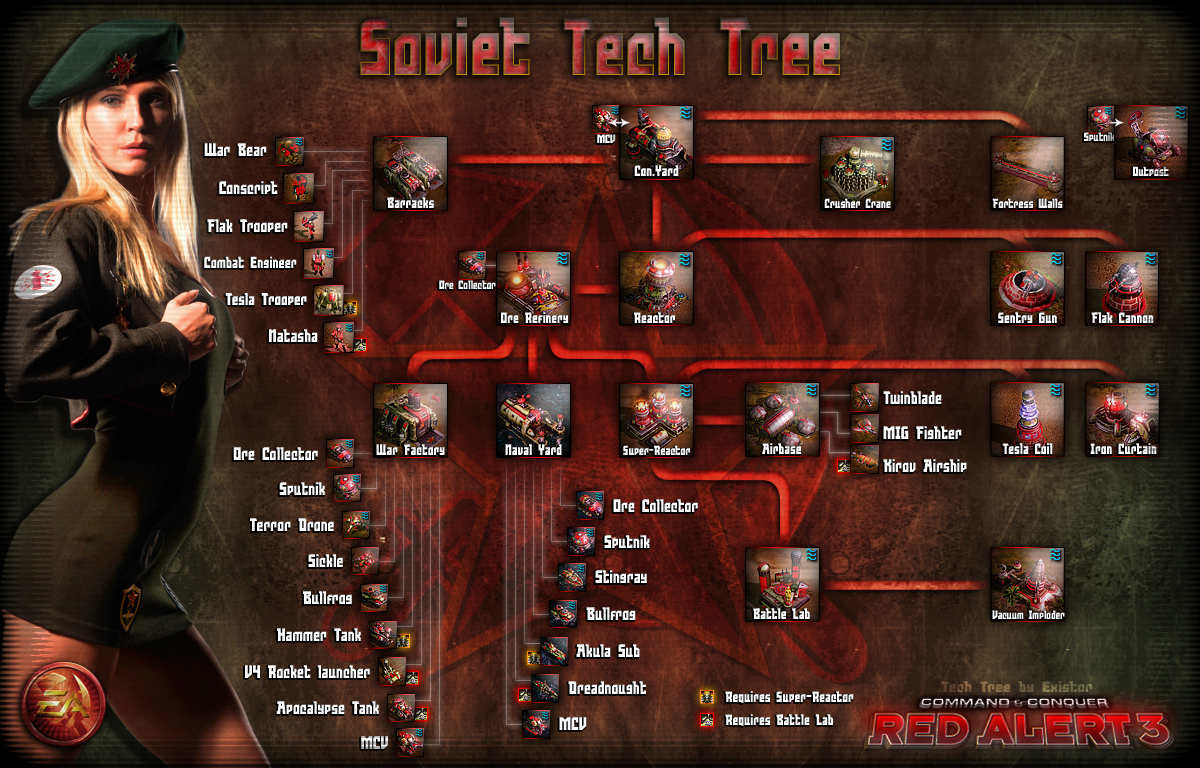
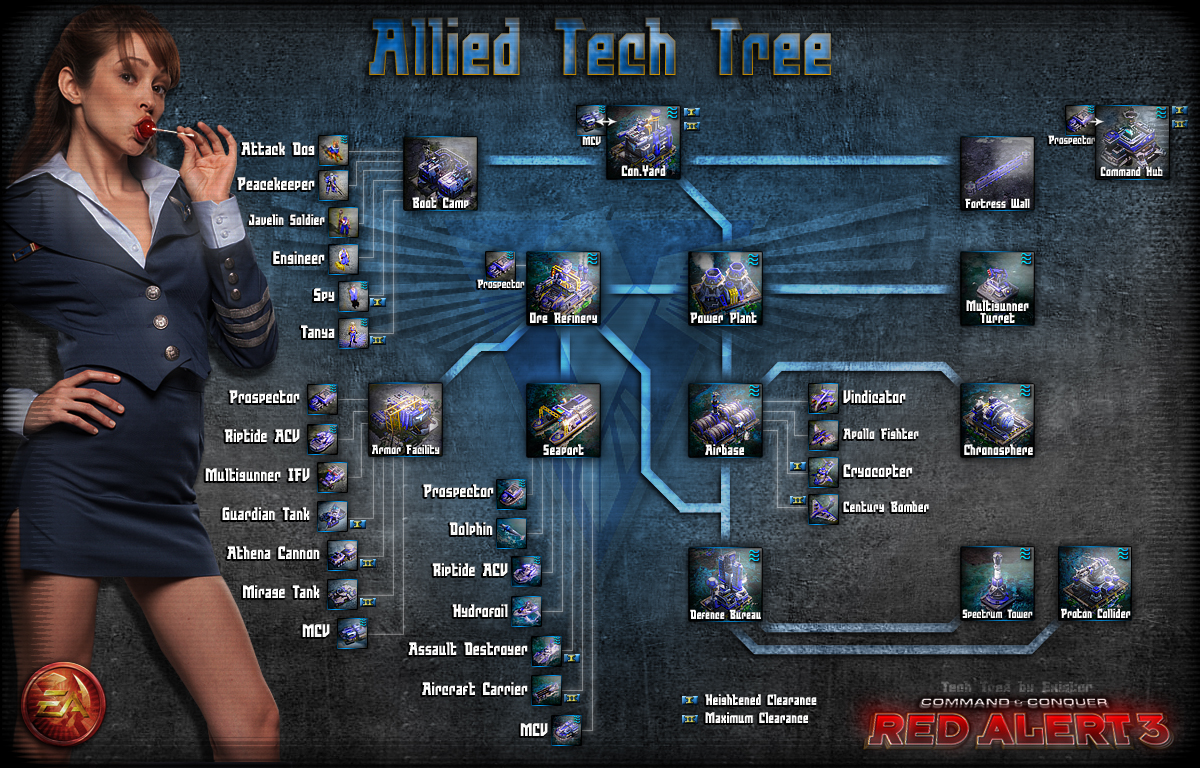
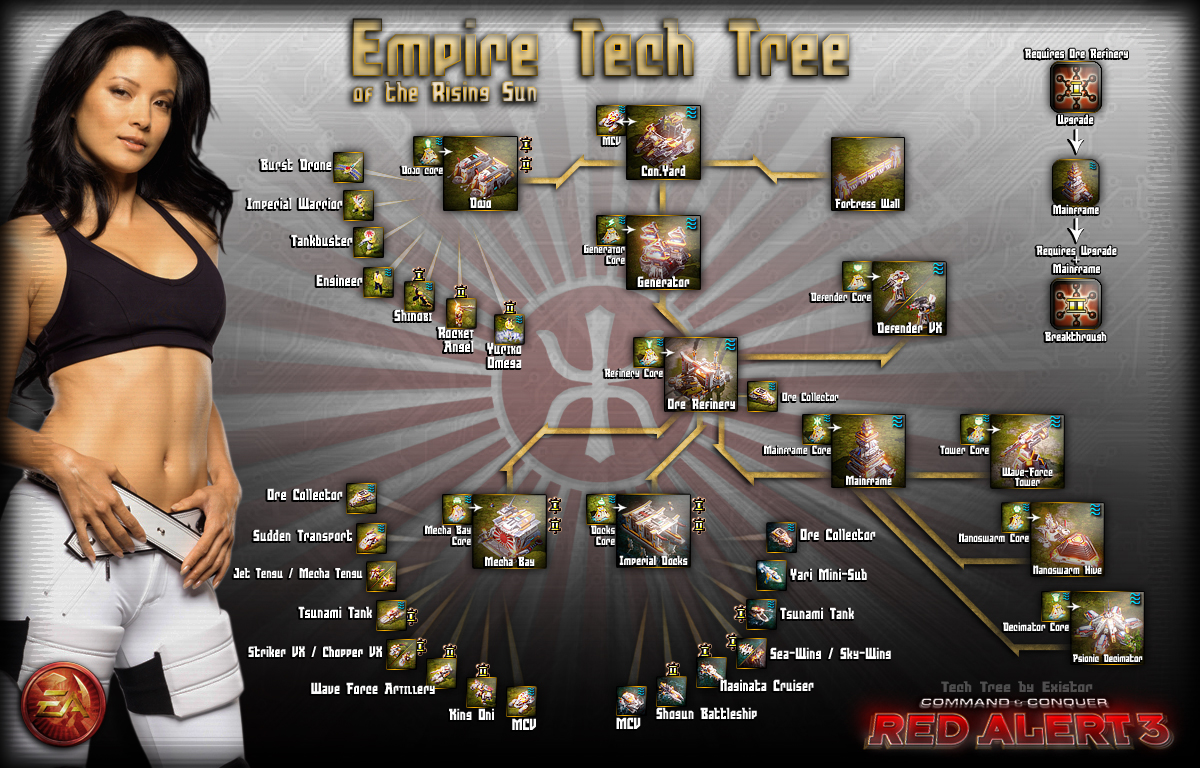
The reasons my expectations were low was because of my disappointment in the Wrath of Kain expansion for C&C3. Now, granted C&C3 itself was an ok game. Maybe not spectacular, but not terrible. RA3 doesn't make a whole lot of improvements over C&C3, but it slathers on the kitschy alternate-timeline jingo cut scenes and really amps up the amusement factor, transforming a mediocre RTS into an enjoyable show (if for not all the right reasons).
The single player campaigns, however, are unforgivably gimmicky. Only in the last mission of each campaign do you actually get unfettered access to the whole tech tree and every other mission also gives you dozens of little hoops to jump through (some admittedly fun, some aggravating in the extreme). Some missions, the gimmick is a simple tech handicap (only lowest tier vehicles, or no tanks, etc), and others it's the C&C signature "you have 1 unit and 1 unit only and if it dies before you pass all the scripted checkpoints you LOSE" horseapples. It makes the game not feel like quite up to being called an "RTS" in the same way you can't quite really in an unqualified manner call a Zelda or Final Fantasy game an RPG. Perhaps I'd better explain that before I upset triple the fanbois in one sentence.
See, in most of the Final Fantasy games, which are billed as "RPGs," you don't actually pick a role and play it. The role is already defined, you just step into control of a brooding spikey-haired protagonist with an oversized sword and set about advancing the plot in the exact same sequence of events every single time with absolutely no open-endedness whatsoever. Compare this to a true RPG such as Baldur's gate, which has so many sidequest diversions and such freedom of exploration that the multiple methods of advancement are absolutely staggering. Not to mention that you roll your protagonist completely from scratch, with an appearance and development path entirely customized by you. This is a similar feeling to RA3, which obviously falls into the RTS category but doesn't actually let you do any strategizing - there is usually one and only one solution to the obstacles set before you, and it becomes more of a point and click action game. The single player campaign experience is practically on rails, as opposed to RTSes such as Dawn of War or Supreme Commander where the entire array of tools is set before you and it is up to you to decide how and when to accomplish the mission (which is invariably destroy the other guys). Though, it is a nice touch to be given the option to play the single player campaign cooperatively with another player. Perhaps it should be classified as a Diet RTS, RTS lite, or to take the opposite metaphor, McRTS (as in the MacDonald's reference to indicate something is lacking substance and overloading on visual appeal, a la McMansion).
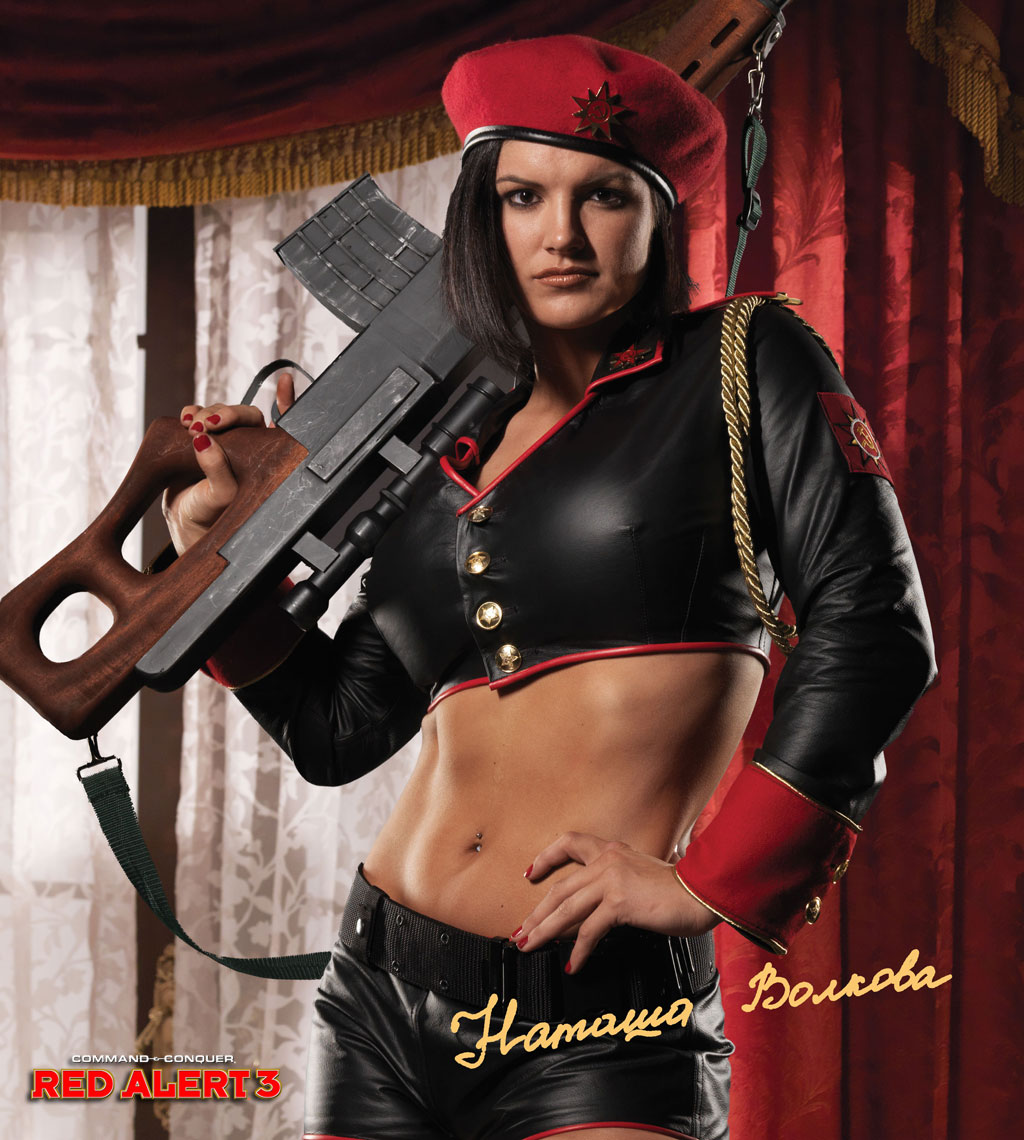
The campaign issues can be largely alleviated by simply playing in skirmish mode, but that deprives you of the cut scenes, which really ARE the Red Alert experience. If you're a fan of bad cinema, you'll love this stuff. Scads of second string actors hamming it up while half-dressed infobabes carry on the transition of cutscene to playfield, delivered with groanworthy dialog in hilarious accents. If you put a gun to my head right now, I couldn't describe Ivana Milicevic (the Russian infobabe)'s face to save my life. They also include more cheesecake shots of the RA3 girls on the quick-reference cards provided in the box, so I guess it's pretty obvious who their demographic is and what they think about them.
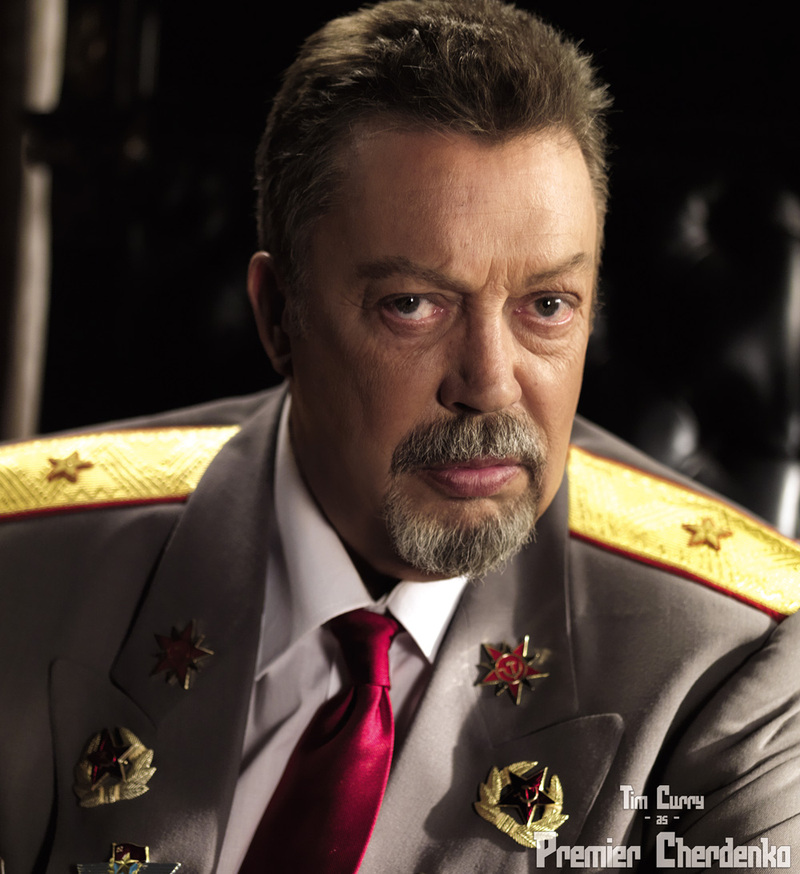
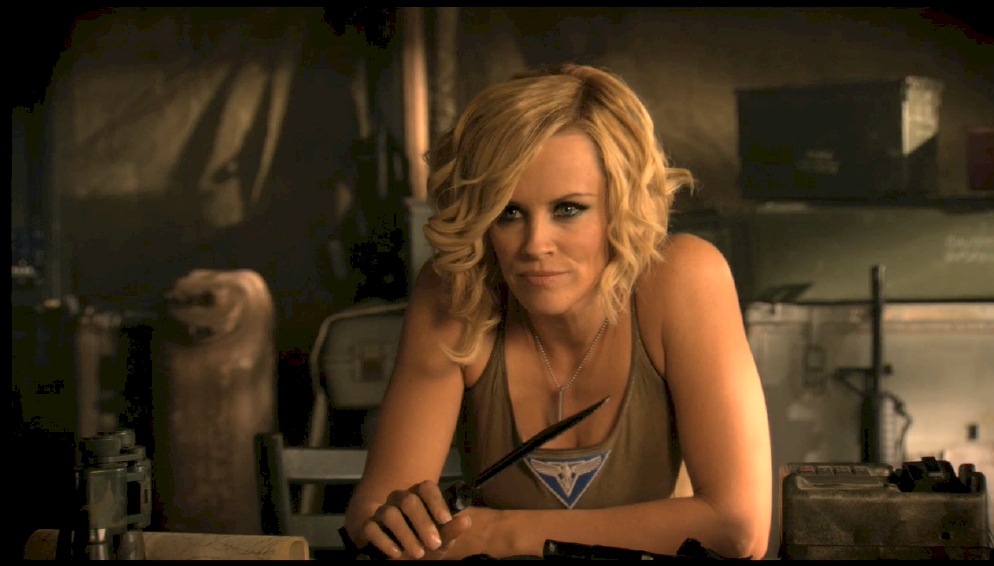
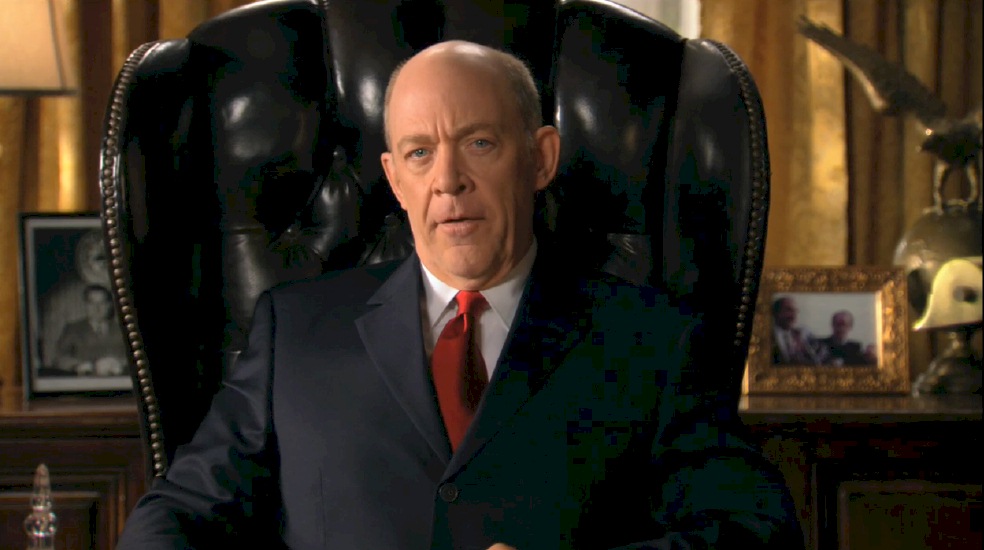
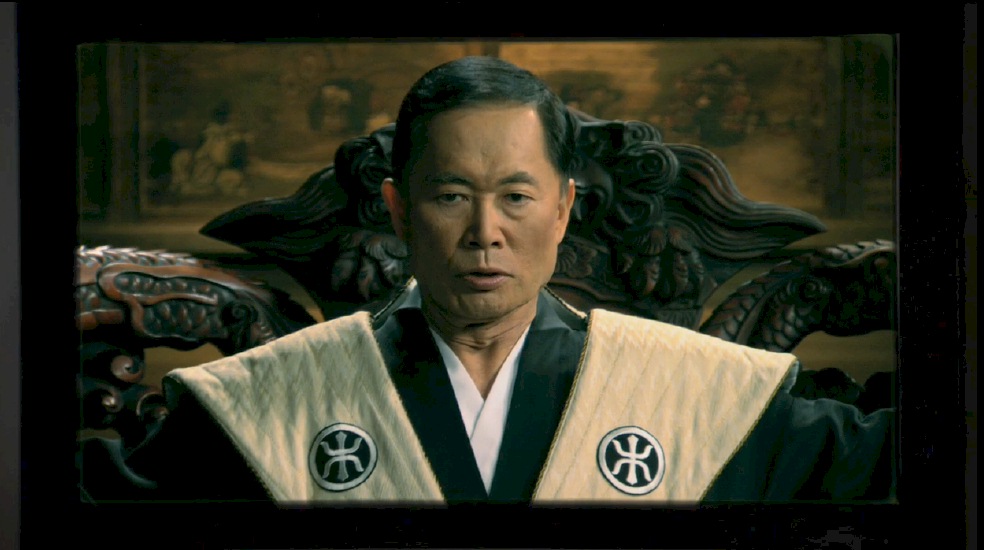
They seem to be using the same costume designers from C&C3 who never quite figured out how to get clothes to fit women properly, but having come to realize this, they incorporated push-up bras and plunging necklines into all female costumes to distract from otherwise mis-tailored uniforms. Gemma Atkinson, who plays the "Allies" infoblonde, has possibly the worst English accent I've ever heard on an English actress - it's like she can't decide if she's from London or Scotland. Andrew Divoff's accent also vacillates between Russian and English, which is a bit puzzling since he married a Russian girl and speaks fluent Russian, so one would think being inundated by it all the time he would have remembered to roll a few more Rs, slur a few more Ws and lift a few more As into Es. And I shouldn't have to say anything about Tim Curry's russian, if any of you has seen the movie Congo. Autumn Reeser is way too goddamned perky, but when is she not? Jenny McCarthy makes a thoroughly repulsive Agent Tanya, reminding us all that McCarthy is a sexy woman only until the instant she opens her mouth to say something. It also doesn't help that the wardrobe department has apparently bisected a golden tabby cat, cleaned out the blood and guts, and put it on her head for a wig. JK Simmons makes a chuckleworthy pastiche of J. Jonah Jameson and George Dubya Bush (and he's forced to spout off every predictable "ugly americanism" from "they hate us because of our freedom" down the list), and as everybody's heard by now, George Takei is cast as the Emperor of the Rising Sun, and does the best with what he's given. Actually the entire asian cast does a passable job as compared to the others. But don't even get me started on the atrocious acting of all the co-commanders of every faction.
It all makes for a circus of the hilariously bad, silly and (incoming saving grace) self-consciously tongue-in-cheek.
But, even in skirmish mode, there are things about the game itself that just rub me the wrong way. Whereas other RTS titles in the genre try to push the frontiers of RTS play with new paradigms, grandiose scale and versatility, the C&C franchise seems chained to just shuffling existing ideas around like cards and then dealing a new hand and calling it a new game. Everything "new" in RA3 is something we've seen in a slightly different combination or configuration in previous C&C or RA titles. In C&C3 I also felt a vague sense of "wrongness" or disconnectedness with everything I did in the game, and it persists in RA3 but I think I've nailed down what it is... nothing moves as I quite expect it to. Airborne units move a smidge too slow, tank units move a smidge too fast, and frankly the whole "strategy" dynamic takes a great big back seat to the "rock paper scissors" dynamic (which admittedly is present in every C&C RTS previous to this one, but) which is ratcheted up and feels like they're trying to squeeze the last bit of toothpaste out of this paradigm. Other games (especially the two aforementioned ones) have shown us that there's more to strategy than configuring the right mix of units in your battlegroup and going gallivanting around the map celebrating invulnerability through diversity. I also found, however, that you don't even necessarily have to do that either... Many a game I won simply by building 3 airfields, building as many Kirov bomber-blimps as I could and winning by explosive attrition.
I was also disappointed to see that the resource gathering dynamic has taken a huge step backwards. No longer are the days where you must worry about the safety of your harvester vehicles as they rumble out into no-man's land to scoop up resources... RA3 now simply allows you to build your "ore processor" immediately adjacent to the "ore mine," allowing your "ore truck" to simply drive back and forth between the two facilities loading and unloading cash-generating "ore" as swiftly as the driver can shift into and out of reverse gear. I don't see why they even really bothered with the separation instead of simply providing you with a building that you build directly ON the mine resource node, which then periodically provides cash every few seconds. And most of the levels thoughtfully provided not one, but TWO such resource nodes in each starting camp, and since your partner player/ai and you split resources (and he/she has their OWN two starting nodes), most levels I never even found the need to go out and claim more mines. You don't even have to build silos to increase your maximum funds cap... it just keeps rolling right in.
It's not all bad though (just mediocre as opposed to terrible). C&C3's brilliant interface scheme returns, allowing for quick and intuitive management of construction at multiple sites and types. The graphics are absolutely beautiful, the action is smooth, the unit models are novel and idiosyncratic, the sound and music are very appropriate and immersive (and a reminder of why some people still listen to C&C music soundtracks even without the games), and as long as you let your brain slip into neutral the live action exposition will make you cackle. The fidelity of the cutscene material is crystal clear and artifact-free.
Unfortunately, as the game emphasizes flash, twitch and (perhaps unintentional) comedy over cerebral strategy and innovation, the replayability suffers despite the skirmish play option provided. But overall I considered it a more positive experience than Kane's Wrath, and so I find myself hesitant to be too hard on the McRTS. I feel it's right on the cusp between C and B, in that I probably will come back and play it again from time to time, but only briefly and not often.
So looks like the 4 races are Space Marines, Orks, Eldar and Tyranids.
Meh, it seems to me that after being used to playing NINE factions in DoW1, going back down to 4 makes me just want to wait until they get back up a few more factions... definitely at least until they add Imperial Guard back in.
Released almost the exact same time as Crusaders: Thy Kingdom Come, I was left to wonder at the coincidence of TWO medieval RTSes being released at the same time by two different companies covering the same rough time period. Because I also had the misfortune to try Crusaders first (review here), I went into this game suspicious of it. It's been a rollercoaster since then.
Put out by 1C Publishing (Formerly Cenega) of the Czech Republic, this game actually would be pretty decent and interesting... if not for a game-crippling bug.
Graphics - While the interface buttons and panels are a little nonintuitive and look slightly dated, the game elements themselves are rendered very well and the game overall is very pretty to look at. You're going to need a computer with some horsepower for this one, as every little foot soldier and knight is rendered fairly detailed. I did have some problems with the camera angles and controls, but they're not the worst I've ever seen.
Audio - The game audio lives up to par, though not much of it is something to write home about. On the plus side, the game makes good use of voiceovers in the tutorial, but on the down... every army you can command uses the same "you clicked me" or "you gave me an order" set of sound files... so every army, be it English or German or whatever, sounds English. A small nit, but I'm going to pick it.
Gameplay - XIII Century is all about battlefield tactics, in a way that really made me feel like I was playing chess only in real time instead of turns. There's a lot going on and a lot of variables. You have units of various type (Archers, Swordsmen, Pike, and there are mounted and foot varieties), a selection of different formations that can then also be packed tightly for bonuses in melee combat or spaced wide for bonuses defending against archers, etc. Certain unit types are at large advantage over others (Pikemen are best at defending against cavalry charges, but archers tear the closely packed pikemen apart, but widely spaced swordsmen charging into the archers defeat them easily, etc), but just as important is use of formations and terrain. Putting your archers up on hills makes them much more accurate. Packing multiple units of pikemen together gives them bonuses, and you want to have their flanks guarded by cliffs or deep forest. Swamps slow down everybody who tries to traverse them, making them easier to pick off with archers.
The campaign consists of historical battles from the 13th century, ranging from England to Mongolia, Russia to the Holy Land. There is no base building and there are no reinforcements to be had.. what you start each battle with is what you get, and it does force you to strategize more carefully.
There are some dynamics to the game, however, I don't agree with. Archers are nearly impotent against each other for some reason. I had 5 squads of my archers attack one squad of enemy archers and my archer squads all ran out of ammo before the enemy squad was half dead. Which reminds me, it may be realistic and all to limit the ammunition of archer units, but I don't think it makes the game any funner and in many situations (such as the one above) it can frustrate the player.
Also, once your carefully arranged formations of troops finally gets into the mix with the enemy, often you won't be able to tell what the hell is going on in the swirling mass of humanity. Sure, there are symbols overhead (one per unit) denoting you've got a unit there, and he's got a unit there too, but most of the time you'll find yourself completely unable to distinguish who is who and which side is winning. The game's refusal to show you any sort of number or health statistics for enemy units adds to this, and is just irritating in general.
But the final killer for this game comes thusly - the game has a bug that breaks it. Flat out breaks it. The devs of the game have acknowledged this problem since April and have promised a patch but as of June there's still no word, because apparently they're busy working on an expansion. Hello? If you're not going to fix the broken software you already sold, why would we want to buy more from you? It also doesn't help that their support forum workers speak in broken, pidgin english (though I must admit, their english is better than my Czechoslovakian... though since there isn't a Czechoslovakia any more, are we supposed to call the language CzechoRepublican?). The bug is this: Every time a unit which has been ordered into a circle formation tries to move, the game gets an "access violation" error which crashes the engine, but not to desktop, so you're forced to end task on the process. It becomes especially gamebreaking because the second battle of the campaign has the enemy AI starting with his pikemen in circle formation, and as soon as you give him reason to move them, game over.
The Verdict- As I said, it was a rollercoaster. I went in with low expectations, was pleasantly surprised, started cresting high enjoying the game, and then had the rug pulled out from under me by the circle-formation bug (which you can't get around other than by not playing the english campaign at all), and the final nail in the coffin was the misplaced priorities of the developer wanting an expansion before a bug fix.
Grade: F
If they ever get that patch out (and I manage to hear about it and can be bothered to go back and apply it and try again), I may regrade this title, but as it is, they might as well be selling an empty box. Too bad, too, because otherwise it would have merited at least a B.
In today's politically-correct social clime, it takes a measure of cojones to put out a game where you orchestrate the crusade against the saracen-held holy land.
Crusaders - Thy Kingdom Come is a real time strategy set during the (you'd never guess) Crusades. The single player campaign follows you as you assume the identity of one of a handful of Crusader leaders, battling your way step by step to Jerusalem. One must admit it is an idea that has some potential, especially for history buffs out there.
It's a pity the follow-through was so bad.
Graphics - The visual layout of this game is something of an anachronism. The rolling hillsides are uncomplex, the user interface panels are rendered merely as a straight 2D graphical overlay with no depth whatsoever, and yet every model... every little knight, archer, tree, rock, shrub, horse, house, tower, flag and blade of grass upon the plains... uses a stupid amount of polygons. The models for the soldiers are actually not bad, but if you ever have the camera down close enough to admire the detail, you won't be even in the slightest effectively commanding your troops. The rest of it just calls attention to the blandness of the art. Is it really necessary to use such high-poly models and high-resolution textures to explicitly depict the utter blandness of the art in this game? All that does is make sure that those who have the hardware to appreciate such things will instead be your most vociferous critics.
Sound - The sound here was an obvious afterthought. The sound effects are just on the "uninspiring" side of stock. The area in which the camera must be placed to hear things like stomping marches and twanging bows pretty much guarantees you won't hear them except when they're irrelevant to what you are looking at. The music is an even worse development - despite being of good fidelity and competent creation, it is the same repeating track over and over again, with moderate parts and high energy parts... and you never quite get over looking for where the action is supposed to be every time the music swells in volume and tempo... only to be discouraged every time. We've been trained that game music is supposed to adapt to the current action or situation in the game, and now to play a game where it does not feels like somebody put pepper in your salt shaker.
Gameplay - Just about everything having to deal with playing this game is bad or wrong. The camera controls are aggravating and nonintuitive. The pacing of levels is such that you're either struggling to keep up with the action or tapping your foot waiting for your soldiers to get where they are supposed to go so you can tell them to do the next thing. Even the ability to double the flow of time does not help much with this. The effects of such variables as cover, stamina and formations seem to be obvious enough but then you can never really tell if they're actually making a difference or not. One thing that is undeniable however, is that your archers are too stupid to avoid shooting your own troops unless you explicitly forbid them from using their ranged attack at all, which kind of defeats the purpose of them.
The only nice thing I really have to say about this game is that there's a novel feature in it of which one of my uncles would approve.. he could never get into most RTSes because, in his words, "any game that allows you to build structures and soldiers as quickly as you can kill them off is bullshit." So, unca would approve of the fact that you can only recruit/rearm your men between missions (and it costs money to do so), and once you're on the battlefield, what you've got is all you'll be getting. It does make for a different strategic style I approve of during combat, and that is placing a strong emphasis on preservation of the lives of your men lacking in most games, where you can just zerg-rush your way to victory as long as you have the cash to replenish on the fly. That's not how it works here. You have limited funds (which you can only spend between missions anyway), and the absence of lost soldiers is keenly felt. I wish more RTSes used dynamics that emphasized the value of using strategy to keep your men alive longer than the enemy.
That said, just about everything else is crap.
Verdict - Grade - D. If not for that one redeeming feature above, this game might have received the first F I've given a game since Derek Smart stopped making games.
This review was a long time coming... and you know why? Because Soulstorm is a long time playing. Seriously. Dawn of War's always been one for lengthy gaming sessions, but now... well, I'm getting ahead of myself.
Soulstorm is the name of the latest "expansion" for the RTS dreadnought that is Warhammer 40,000: Dawn of War. I put "expansion" in quotes because it doesn't quite fit with my definition of what a game expansion usually is. Usually, a game "expansion" is a lower priced piece of addon software which injects an amount of new content into an existing game, and that amount is usually somewhat less than that with which the game originally shipped. But this isn't the case with this franchise.
Each expansion in the DoW series is like a complete reinvention... or rather, a "do-over." As if they have told us, "Here's the game, enjoy. Whup, no wait! HERE's the game, this is better. That'll be another full price please. Thank you, enjoy. No wait, HERE! This is EVEN better!" and so on and so forth. The irritation I would generally feel at being yanked around like this, repeatedly and at full price, is mitigated by the fact that each time it IS bigger, and it IS better. And, like most Warhammer enthusiasts, I seem to have enough disposable income so as not to worry about how much I'm pushing down the same rathole.
I thought the previous expansion, Dark Crusade, was impressive with its 7 factions vying amongst each other. That was a remarkable increase from the previous 5 factions, and the Necrons and Tau made a very interesting addition with unconventional paradigms for play. This time around, Soulstorm has added yet another two factions: The Sisters of Battle, and the Dark Eldar. After the fresh and new feeling of the previous two races, a lot of people (myself included) raised the proverbial skeptical eyebrow at the latest addition seeming a little less than inspired... after all, the Necrons and Tau were dynamic and new... and compared to them, it was easy to write off the Dark Eldar as just a new paint job and the Sisters of Battle as "Space Marines with Boobs." Added to the fact that "Chaos" is basically "Dark Space Marines," and one was led to wonder if the ol' idea bucket was starting to run low.
Well, I am pleased to say that my reservations proved to be unfounded. The two new factions are not mere copies of any of the other factions any more than any given faction is a copy of all the rest. That is, to say, they still must adhere to the same light infantry / heavy infantry / light vehicle / heavy vehicle / artillery / superunit / hero force commander paradigm that all the factions use, but the artistry and methodry of the new races is still different enough to feel unique among the now very crowded playing field of 9 factions.
When I read that the new expansion's campaign would span an entire system (as opposed to the single planet in Dark Crusade), I was simultaneously eager and worried. Turns out I needn't have been worried. Although the scope of the battle has increased to spanning 4 planets (and some moons), the number of actual territories hasn't gone up fourfold. But there is still more ground to cover, and some new rules governing movement from one planet to another. A "warp storm" has emerged in the system making conventional space travel unusable, so to get from one planet to another requires the use of "ancient gates," which generally only connect to two other ancient gates. This dynamic prevents any player from just attacking anywhere, there's still a sense of having to conquer your way from point A to point B step by step. There's also a "supply lines" rule that prevents you from gaining resources from your territories that are cut off from you.
The one gripe I have with the expansion is, unfortunately, what was supposed to be one of its big selling points - Air units. Here, they definitely took the cop-out approach. Each faction gets a new "air vehicle" type, but for all intents and purposes these things are just ground units that can move anywhere regardless of terrain. They don't have to land, they don't have to refuel, and really they don't feel that special or even useful. They don't even have the decency to look like they're flying in a holding pattern... they just hang there defying physics until you tell them to move, like a Warcraft 2 Goblin Zeppelin or Gnomish Flying Machine. Typically their normal weapons are rather lackluster and they rely too heavily on timered abilities, meaning that they require a lot of micromanagement. The benefit they provide doesn't really justify their use of your precious and limited vehicle cap. The final straw for my mental dismissal of them came when I destroyed an Ork "Fighta-Bomma" with ground-targeted artillery.
Well, there's one other gripe, too, but it is a small one and doesn't really apply to me. The publisher chose to stick it to late adopters by making it so that you can't play as Tau or Necrons unless you already own Dark Crusade, and put your Dark Crusade CD Key in to a special place in the game's options. Thus, you can't just buy the latest WH40k:DOW game and be up to date. That seems particularly money-grubbing of them, but then I guess Games Workshop has always been about the grubbing of money. See that link 5 paragraphs above.
But aside from that, it's still a worthwhile play and a fun time. Not for the casual gamer, but what about Warhammer has ever been for the casual gamer? One last Caveat - the game itself still sports a very claustrophobic level of zoom. I don't know why they seem to think that if we can see more than 8 units at once we'll somehow be having less fun (or perhaps too much), but there's this mod out there which fixes that problem and then it's full speed ahead from there.
Verdict: A-. It's a great big ball of awesome only tarnished by a few blotches.
When I eagerly sank my claws into the long awaited, long hyped Command and Conquer 3, some will recall I was actually a little disappointed. The only thing I had to really praise about it was that it had one of the best user interfaces ever conceived for an RTS and decent current-gen graphics, but the rest of the game felt like it was just going through the motions and rehashing territory already well covered.
I was excited to get ahold of the new expansion for C&C3, called Kane's Wrath. This is because I remember Command and Conquer: Generals. Generals itself was much like C&C 3 at first... a mediocre RTS with decent graphics (for the time), but it also tried something new: a 3 way fight (which is also present in C&C 3) with specific strengths and unique paradigms for each faction. The problems with C&C:G (along with many of the bugs) were ironed out with the advent of the Zero Hour expansion, which (until Supreme Commander came along) made it bar none the best RTS released thus far. So I was hopeful that Kane's Wrath could do for C&C3 what Zero Hour did for C&C:G.
Well, that'll teach me to get my hopes up. Kane's Wrath tried to fix what was not broken and ignored most of what irked me most about C&C3. Oh sure, they tried the same thing with introducing subfactions into the mix, but honestly the subfactions do not differ enough from one another to really alter the way you play the game (unlike the Zero Hour factions). Additionally, the game attempts to rest on it's UI laurels. While every single other RTS on the market has adopted the standard "shift click to queue orders" methodry, C&C3 Kane's wrath still insists on forcing you to use its counter-intuitive "planning mode" to queue up multiple orders. And you can forget about units of different speeds moving in formation. The UI may have been revolutionary at original release, but it has stood stock still in the expansion, making no improvements. The biggest problem with C&C3, though, is that the individual unit AI is still beyond idiotic and all your units require massive amounts of micromanagement to survive, much less be effective. The autoresponse radius seldom is suitable, units set to guard chase MUCH too far, and units seldom select the correct target of their own volition (not to mention that to attack any noncombatant building still requires an explicit click, no matter how close it is). Often I was left wondering if my units were REALLY as stupid as they appeared to be, or if it was specifically designed to be another "obstacle to overcome."
See, in EA:Los Angeles' (the specific branch of EA responsible for this atrocity) estimation, inserting as many irritating obstacles as possible for you to feel good about overcoming is the fun of the game. You can tell this especially in the single player campaign by the number of bullshit "do this in 5 minutes without letting any engineers die, even though they can't survive a single hit" missions thrown at you. There were a few in the original campaign, but they come thick and en masse at you in the expansion. I hope you like clicking "restart mission," sucker... because often times the game won't even let you get a rudimentary base under you before it starts sending tanks and infantry in combined forces, along with airstrikes. And as with the original, there are plenty of "surprise, instant enemies, you lose, sucker!" moments.
Also, there's some line of sight issues. Often a single enemy bazooka solder lying just over the crest of a hill will be able to kill an infinite number of my defensive structures if I leave him alone long enough (and of course none of my units are smart enough to go out and shoot him without explicit micromanagement).
So the campaign is a complete write-off as far as I'm concerned. It doesn't even help that they produced more of C&C's signature cut scenes, complete with the usual level of overacting. The gameplay was enough to put me off them. The skirmish mode is still present, thank goodness, and some fun is at least possible there because your tech trees aren't neutered for the sake of the story and your victory conditions aren't in "super fun EA bullshit obstacle mode," so you can actually maybe enjoy the game a little, despite still having units so dumb that you often wonder if they die of enemy fire or of spontaneous unexplained brain death. I can't count how many times my infantry ran right through tiberium, dying halfway through (and naturally I can't shift click to set travelling waypoints AROUND the tiberium without entering the ponderous "planning" mode), and how many times my anti-armor decided to concentrate on the infantry first while my anti-infantry units concentrated on the armor, leading to their destruction and the game laughing as my base collapsed.
Oh, and any single unit with a flamethrower can level your entire base in under 10 seconds.
They also added one more mode of play called "Global Conquest," which is EA trying to do something to compare with WH40k-DOW's new campaign style (IE, global planning done from a turn based perspective, and zooming in to individual conflicts to play RTS). It seemed interesting enough at first until I suddenly realized that what I liked most about it was that it had the option to "autoresolve" any conflict, which I used all the time. It clicked. What I most liked about this new mode in the Command and Conquer 3 expansion was that it let me choose not to play Command and Conquer 3.
The Verdict- If C&C3 hadn't come out and the content in this expansion had been part of the C&C3 original release, I still would have given it a B before, but as this is an expansion, it is held to different standards. An expansion is supposed to address issues and introduce innovations, not exacerbate or ignore issues and introduce new ways to play whose principle lure is that they don't make you suffer through the actual game. Thus it is that I award Kane's Wrath with a well-deserved D and extend every middle digit I have in EA's direction. It isn't even worth the reduced price, in my opinion.
Grade: D
For full post/permalink, click "Read Full Article"